Showing posts with label it. Show all posts

Sunday, March 29, 2015

2015 Honda CR V Touring Review It Does Most Things Better

2015 Honda CR-V Touring rear Tufts Cove
The Honda CR-V was Canada’s best-selling SUV in each of 2015s final two months, just as it was in America in seven of the last eight years. (We’re using the term “SUV” loosely here in order to avoid constant delineation.) Canadian and U.S. CR-V volume increased to previously unseen levels in 2014.

American Honda reported 335,019 CR-V sales last year, 28,807 more than Ford managed with its second-best-selling Escape. Honda Canadas CR-V volume was up 9% to 37,684 units.

THE GOOD
• Bigger inside than outside

• LKAS is a wonder
• Nimble but stable
• Ride quality
• 185-bhp is sufficient
THE BAD
• Aggravating touchscreen
• Irritating buttons beside touchscreen
• Not a looker
• Real-world fuel consumption
• More power wouldnt go amiss

North American consumers look favourably upon Honda’s reliability reputation. The CR-V is also a long-established nameplate in a relatively fresh category. But there must be numerous other reasons for the CR-V’s wild success.

More specifically, there must have been numerous other reasons at the tail end of 2014, as a refreshed 2015 CR-V like the one Honda Canada sent to our driveway began to outsell not only all other SUVs with increasingly large margins but also all passenger cars, as well.

Clearly tens of thousands of consumers are willing to overlook the CR-V’s faults, few though there may be. 
2015 Honda CR-V Touring front Tufts Cove
2015 HONDA CR-V TOURING
Base Price: $ $27,785 *
As-Tested Price: $ 38,335 *
Engine: 2.4L DOHC 16-valve I-4
Transmission: continuously variable
Horsepower: 185 @ 6400 rpm
Torque: 181 lb-ft @ 3900 rpm
Curb Weight: 3642 pounds
Drive Type: all-wheel-drive
Length: 179.4 inches
Width: 71.7 inches
Height: 65.0 inches
Wheelbase: 103.1 inches
Tires: Michelin X-Ice
Tire Size: 225/60R18
Passenger Volume: 2873 litres
Cargo Volume: 1054 litres
Max. Cargo Volume: 2007 litres
EPA City: 26 mpg
EPA Hwy: 33 mpg
NRCAN OEE City: 9.1 L/100km
NRCAN OEE Hwy: 7.2 L/100km
Observed: 23.8 mpg
Observed: 9.9 L/100km
* Canadian dollars, includes $1795 in fees.
AWD CR-Vs start at $30,145.
MPG fuel economy ratings from the
Environmental Protection Agency.
L/100km ratings from the Canadian
Office of Energy Efficiencys new
5-cycle testing for MY2015 vehicles.
The CR-V’s new continuously variable transmission, implemented surprisingly well alongside the a 185-horsepower 2.4L four-cylinder, periodically allows revs to fall so low that an unnecessary amount of vibration enters the cabin. 

This Touring-trim CR-V is the full meal deal, but it lacks any form of power adjustment for the passenger seat. 

The interior, particularly at this lofty CAD $38,335 price tag, is mostly inoffensive but offers luxury only in terms of equipment, not in its materials or design flair. And the interior can certainly offend, with Lilliputian buttons accompanying a touchscreen which failed on all but one occasion to come to life before the five-minute mark of a morning drive. 

Speaking subjectively, the CR-V is not the prettiest girl next door – Paris’s Place de lÉtoile doesn’t have as many intersecting lines as the CR-V’s front end. We’re also left to wonder why Honda hires wheel designers whose efforts wouldn’t be good enough for Pontiac circa 2001.

However, the CR-V is near perfect where it counts. It’s less than 180 inches long but packs 2873 litres of completely usable passenger volume into the tidy package. Rear seat passengers enjoy a flat floor that makes three-across trips a distinct possibility. Rear seats up, the CR-V provides 1054 litres of cargo capacity. The Ford Escape is one inch shorter than the CR-V, bumper to bumper, but offers 8% less cargo volume, 3% less passenger space, and 4% less rear legroom. It feels like the dimensional differences are more distinguishable than those figures suggest, especially aft of the rear seat.

For young families who might have sought out an Accord in a previous era, the 2015 CR-V’s space efficiency, easily accessed seat-folding levers, low load floor, and semi-lofty ride height form a winning ticket.
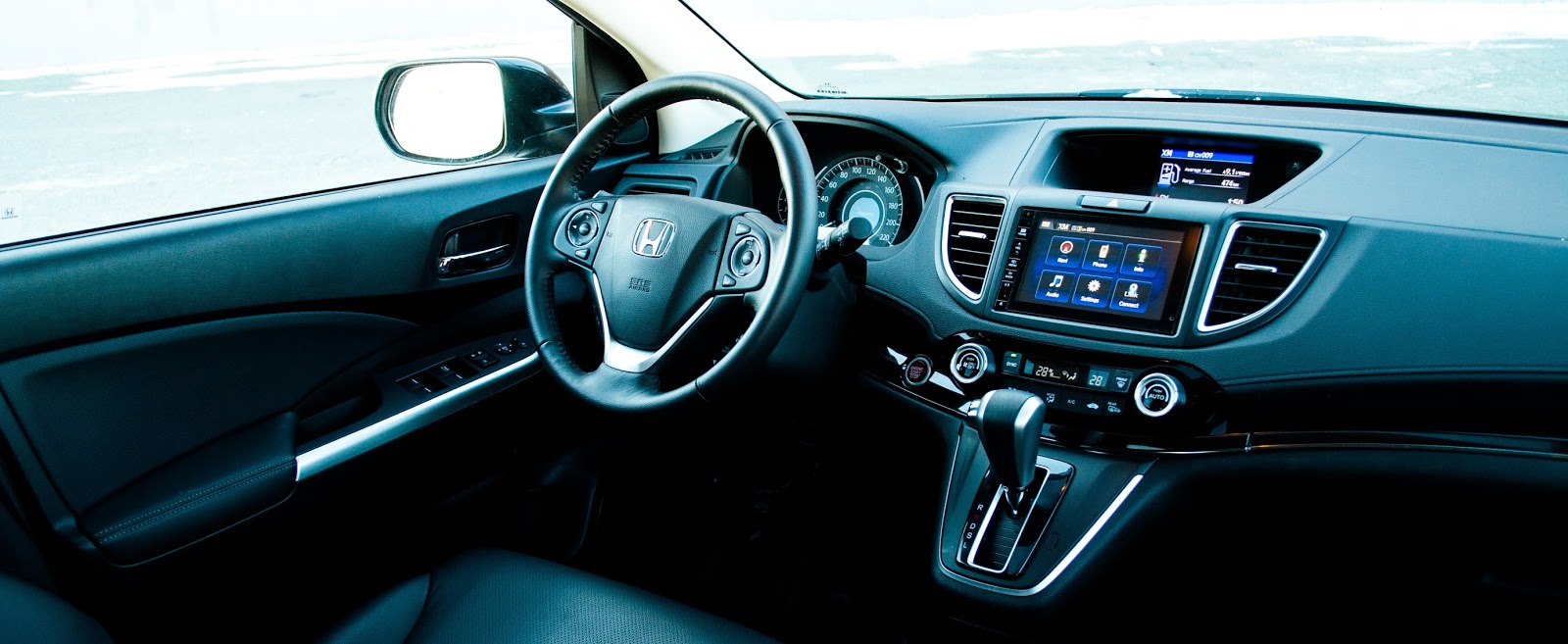
2015 Honda CR-V Touring interior
Fortunately, it drives nicely, as well. There is nothing sporty here, although the steering is well weighted and the brake pedal is nicely modulated. The CR-V accelerates more swiftly than you might expect for a 3642-pound high-rider: Car & Driver says 0-60 mph takes 8.2 seconds. Especially as revs rise to a more Honda-like level, the CR-V doesn’t require more power, but don’t take that as an indication that the CR-V will adequately satisfy your urge to scoot up off-ramps like your fellow hockey parents in their Santa Fe Sport 2.0Ts and Forester XTs. It won’t.

The CR-V may not ride quite as sweetly for MY2015 as it did before the refresh, but overall refinement is still the name of its game. Of greater consequence is the fact that the 2015 CR-V continues to marry subdued ride quality to a nimble chassis. Honda engineers crafted an SUV that feels decidedly compact in routine driving and one which remains rather level-headed through corners, seemingly treading the middle ground between the mature Nissan Rogue and the enthusiastic Mazda CX-5.


• Historical Monthly & Yearly Honda CR-V Sales Figures
• 2013 Toyota RAV4 LE Driven Review
• 2014 Honda Accord Hybrid Driven Review
• 2014 Mazda CX-5 GT Driven Review
• 2014 Nissan Rogue SL Driven Review


2015 CR-V Tourings include most of the features from Honda’s storehouse: all-wheel-drive, navigation, LaneWatch (right side only, of course), keyless access, perforated leather seating, power tailgate, sunroof, and a bevy of safety abbreviations from ABS, EBD, and VSE to CMBS, ACC, LDW, and LKAS, the final being a semi-autonomous steering function that helps to reduce driver fatigue on long highway stints.
2015 Honda CR-V Touring touchscreen
CR-Vs start at $27,785 in LX trim. All-wheel-drive adds $2360 to the price of an LX-trim CR-V but power is sent to all four wheels in each of the upper trim levels: the $31,685 SE, $33,685 EX, $35,685 EX-L, and the $38,335 Touring. We averaged 9.9 L/100km over the course of a week with the CR-V Touring AWD, which tips the scales with 145 extra pounds compared with the base all-wheel-drive CR-V. Cold temperatures, winter tires, frequent snow coverage, and a disproportionate amount of time spent in the city caused the CR-V’s observed fuel economy to come up short of the official Natural Resources Canadas 9.1 L/100km city rating.

The CR-V is certainly not the most exciting small utility vehicle on the market today, nor is it the only one capable of cramming a shocking amount of humankind and stuff into a small space. But it does most things better than most of its potential competitors. There are a couple of niggling issues Honda could quickly resolve, but clearly no issues Honda needs to resolve in order to keep the CR-V at the top of the sales leaderboard.

Tuesday, March 17, 2015

2014 Audi SQ5 Review It Plays Tunes

2014 Audi SQ5 rear view
The number of double-takes was odd, I thought. In the summer, with the top down in a red Camaro ZL1, rubberneckers are a dime a dozen. But the SQ5 is a subtly enhanced version of the Audi Q5, a small crossover that’s been around for more than five years; the top-selling premium brand utility vehicle in Canada in 2014. 

Sure, this one has optional 21-inch alloy wheels, valued at $1000, but are big wheels enough to cause the majority of passersby to turn for another look?

THE GOOD
• Straight-line pace

• Classy cabin
• Still looks good
• Handles like a sporty car
• 8-speed auto is a marvel
THE BAD
• Small cargo area
• Blanked-out switches? Cmon
• Wind noise
• Handles like a sporty car...
• ... most of the time

Ah yes, the noise, that’s what did it. Audi’s supercharged 3.0L V6 does have the tendency to bark melodically, particularly when Audi Drive Select is used to switch engine noise (along with engine/transmission and steering) to Dynamic mode, up a notch from Comfort and Auto. Added to that was the 14-speaker Bang & Olufsen sound system, which was used extensively at wake-the-neighbours volume. How civilized.

Less civilized is the amount of understeer and the way that understeer is encountered prematurely. Yet that’s only a surprise because of the dynamics manifested by the SQ5 most of the time – it’s not a high-riding SUV that you drive like an SUV. At all. 
2014 Audi SQ5 Technik
2014 AUDI SQ5 TECHNIK
Base Price * (CDN): $61,595
As-Tested Price * (CDN): $68,695
Engine: 3.0L DOHC 24-valve supercharged V6
Transmission: 8-speed automatic
Horsepower: 354 @ 6000 rpm
Torque: 347 lb-ft @ 4000 rpm
Curb Weight: 4409 pounds
Drive Type: all-wheel-drive
Length: 183.0 inches
Width: 75.2 inches
Height: 65.3 inches
Wheelbase: 111.0 inches
Tires: Dunlop SP Sport Maxx GT
Tire Size: 255/40R21
Passenger Volume: 2860 litres
Cargo Volume: 824 litres
Max. Cargo Volume: 1623 litres
EPA City: 16 mpg
EPA Highway: 23 mpg
NRCAN OEE City: 14.9 L/100km
NRCAN OEE Hwy: 10.1 L/100km
Observed: 18.7 mpg
Observed: 12.6 L/100km
* includes $1995 destination charge
SQ5 Progressiv base price: $59,395
MPG fuel economy ratings from the
Environmental Protection Agency.
L/100km ratings from the Canadian
Office of Energy Efficiencys new 5-cycle
testing for MY2015 vehicles.
Naturally, when taking corners like the TTS you forgot it wasn’t, the SQ5 plows sooner and with more disconcerting pressure on the outside front tire than you expected. After all, you forgot you were driving a 4400-pound, 65.3-inch tall utility vehicle, not a 3858-pound, 55.4-inch tall S4.

That you could forget something so obvious is a testament to the SQ5’s overall balance. Of greater interest to those who prefer the SQ5 over conventional Q5s like the 220-horsepower 2.0T and 240-horsepower 3.0L TDI because of the SQ5’s rate of acceleration, ride quality is firm but compliant over the worst roads, if slightly busy in routine driving.

But what acceleration it is. The SQ5 is less expensive than other hyper-quick SUVs, the AMGs and M-badged BMWs, less costly than the Jeep Grand Cherokee SRT, as well. Audi’s supercharged 3.0L, with 354 horsepower and 346 lb-ft of torque, is mated here to an 8-speed automatic, not the 7-speed dual-clutch from the similarly-engined S4.

Not at any moment do you feel as though the meat of the power band is located elsewhere, although Comfort mode does seem to use very economy-minded programming for the 8-speed auto, refusing to drop down a gear without a real kick in the pants. 

Audi’s famed Quattro all-wheel-drive means firm prods of the throttle always result in instantaneous forward motion almost regardless of surface. (We’d strongly recommend something other than 255/40R/21 Dunlop SP Sport Maxx GTs if you’ll be driving in snow. Nothing kills the benefits of all-wheel-drive quite like skipping out on winter tires.)

The true brute force of the supercharged V6 is felt not from rest but at speed, however. Squirting around traffic to get to an off-ramp ahead, rather than behind, of a line of slow-moving CR-Vs and RAV4s is a task completed with shocking quickness.
2014 Audi SQ5 Technik front
All Photo Credits: Timothy Cain ©www.GoodCarBadCar.net
Click Any Of These Images For A Larger Slideshow View
All the while, SQ5 pilots are ensconced in a typically classy Audi interior. There are letdowns. For starters, the interior doesn’t feel fresh, perhaps because of the overarching darkness. Even the optional aluminum inlays ($1100) don’t spice up the ambience. I wouldn’t say the SQ5 offers luxury-like silence, either, with wind noise being rather prevalent. 

There are a number of blanked-out switches in prominent locations, too, which always causes you to wonder what you’re missing out on after spending $68,695. Audi’s MMI is simple, though, with shortcut buttons spread around a central control knob, and everything feels so very expensive. As it ought to.
Rear seat space does not stand out, not for its snugness or its abundance of space. Yet cargo dimensions are a letdown. The Q5 is 183 inches long from bumper to bumper and 75.2 inches wide. That’s nearly five inches longer and nearly four inches wider than the Honda CR-V, but the CR-V offers 24% more seats-folded cargo capacity and 28% more space behind the rear seats. The SQ5 remains a flexible cargo carrier, but the sloping roof which helps to make all Q5s so handsome reduces the SQ5’s ability to take a young family away on vacation.

The SQ5 is not alone in this luxury crossover cargo conundrum: GLKs and X3s are also down on luggage capacity compared with America’s similarly-sized top-selling utility vehicles.
The Audi SQ5 is the fast Q5, an older and popular vehicle, and thus a common vehicle. It’s also tiny in the back and, not unexpectedly, quite a guzzler. We averaged 12.6 L/100km during the week Audi Canada allowed the SQ5 to visit our driveway, in keeping with its ratings, and appropriate if it were a pickup truck. Fortunately, Audi adds a healthy dose of standard equipment to the SQ5’s performance credentials, the kind of stuff we often see on premium brand option sheets: panoramic sunroof, power tailgate, three-zone automatic climate control, keyless access, twelve-way power seats with driver memory.


• Historical Monthly & Yearly Audi Q5 Sales Figures
• 2015 Porsche Macan S Driven Review
• 2014 Audi S4 Driven Review
• 2013 Tesla Model S P85 Driven Review
• 2014 Cadillac SRX AWD Driven Review


One could make an argument that with this amount of power, unavailable in the Q5’s direct rivals, and this level of equipment, the SQ5 is making an overture to the value-conscious corners of our brains. Meanwhile, the SQ5 is also playing another tune, courtesy of Bang & Olufsen and a supercharged 3.0L, in order to tug on our heartstrings.